
Semiconductors
The Capacity Everyone Is Counting On Is Not the Capacity That Exists Today
Announced fab investment isn't available supply. The gap between capital committed and capacity delivered — 36 to 60 months, plus a single-supplier bottleneck above the fab layer — is where the real planning risk sits.
By Vaxa Market Intelligence Team
4 min Read
Published on July 28, 2026
Sector Snapshot — Semiconductors
01
$133B global 300mm fab equipment spending in 2026, up 18% year over year
02
$1.5T projected global fab investment between 2024 and 2030 — equal to everything invested in the prior 20 years
03
36–60 mo typical timeline from groundbreaking to commercial volume production for a new fab
04
70%+ of new global fab capital still flowing into Asian markets despite Western reshoring efforts
Market Consensus & Vaxa's Position
More announced fab investment translates directly into more available capacity, sooner — the capital committed is a reasonable proxy for the supply coming online.
The gap between capital committed and capacity delivered is the actual planning risk. A new fab is 36 to 60 months from groundbreaking to commercial volume at minimum — and even a fully funded, fully reshored fab still depends on the same single equipment supplier for its most advanced tools. Geographic diversification of fab capacity doesn't diversify that dependency at all.

The Shift
The capacity everyone is counting on is not the capacity that exists today.
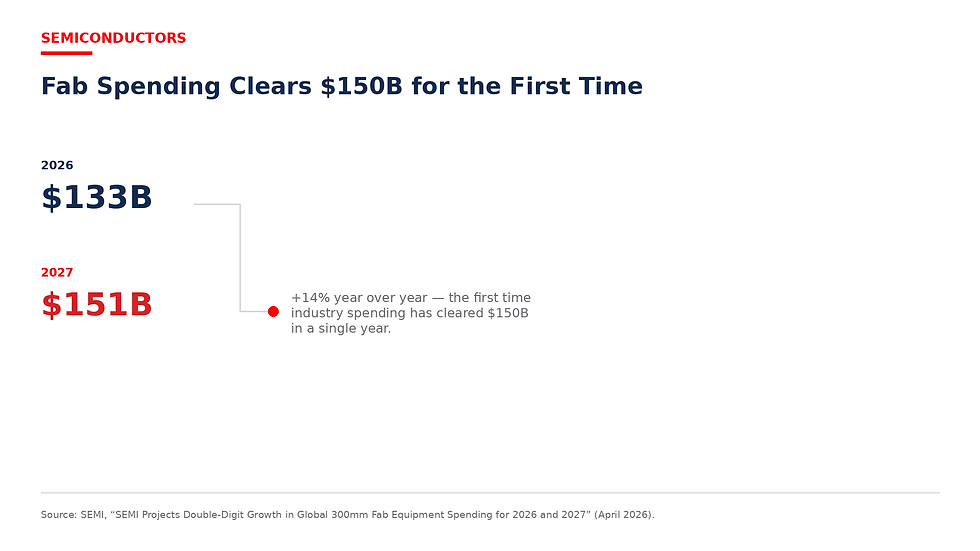
The scale of the current semiconductor buildout is genuinely unprecedented. Global 300mm fab equipment spending is set to rise 18% to $133 billion in 2026, and a further 14% to $151 billion in 2027 — the first time industry spending has cleared $150 billion in a single year. Over the full 2024-2030 window, cumulative fab investment is projected to exceed $1.5 trillion, roughly matching everything the industry invested in the previous two decades combined.
AI demand is the proximate driver, but the deeper shift is structural: semiconductor manufacturing has gone from a specialized industrial category to a central pillar of national economic and security strategy. The CHIPS Act, the EU's semiconductor strategy, and comparable programs across Asia are not incremental policy support — they are treating fab capacity as strategic infrastructure, on par with energy or telecommunications.
For companies planning around this capacity — as customers, suppliers, or investors — the risk is treating announced investment as a proxy for available supply. It isn't. The gap between capital committed and capacity delivered is where the real planning risk sits.
The Timeline Problem
A new fab takes three to five years. Most planning cycles do not.
Semiconductor fab construction is among the most complex industrial builds in existence — advanced cleanrooms, ultra-high-purity water systems, specialized HVAC and gas distribution, seismic isolation, and vast electrical infrastructure. Even a mature-node fab (28nm-65nm) now averages $4.5 billion in capital expenditure, driven by localized labor constraints and material inflation. From groundbreaking to commercial volume production, the realistic range is 36 to 60 months — and that is before accounting for the ramp to full yield.
Texas Instruments' Sherman, Texas facility — the largest private-sector investment in Texas history, at roughly $30 billion — broke ground in 2022 and began early production phases in 2025, several years after the investment was first announced. Its companion Lehi, Utah fab, an $11 billion project announced in February 2023, is targeting production as early as 2026. These are not delays. This is the normal timeline for advanced fab construction, even for one of the best-resourced companies in the industry, and it is longer than most procurement and supply chain planning horizons account for.
The practical consequence: for industrial MCUs, power management ICs, and other components where lead times are already stretched to a year or more, waiting for new fab capacity to relieve the shortage is a supply chain risk in itself. Independent distribution channels and strategic last-time-buy positions are functioning as the bridge for procurement teams who cannot afford to bet a product roadmap on capacity that is still three years from commercial volume.

The Concentration Problem
Reshoring is real. It has not changed where the capital actually goes.
Despite years of CHIPS Act incentives, EU strategy, and comparable programs across Asia, PwC's analysis puts more than 70% of projected global fab investment through 2030 still flowing into Asian markets. China, Taiwan, and Korea continue to command the largest share of committed capital, with the Americas, Japan, and Europe expanding from a materially smaller base. Reshoring is real and accelerating — it has not yet changed the center of gravity.
A second concentration sits above the fab layer entirely: EUV lithography. ASML is currently the only company in the world that manufactures the extreme ultraviolet lithography machines required to produce chips below 7nm — a 100% share of EUV and roughly 90-94% of the broader lithography market — and without those chips, there is no frontier AI hardware. Every new fab built anywhere in the world, regardless of which government incentive funded it, represents incremental demand for that same single equipment supplier. Geographic diversification of fab capacity does not diversify this dependency at all.
This matters for how companies read "supply chain resilience" claims in this sector. A new domestic fab reduces exposure to a specific geography. It does not reduce exposure to the equipment and tooling bottlenecks that sit upstream of every fab, wherever it is built.
What This Means for Strategy
Capital allocation is shifting from capacity-driven to capability-driven.
The chip industry itself is adjusting for this. Rather than simply adding more fab or chip platform capacity, leading players are increasingly pursuing strategic partnerships and direct investment to build ecosystems around their platforms — what some analysts term circular financing. The capital allocation question is shifting from "how much capacity can we add" to "what system-level differentiation can we build," because raw capacity is no longer the binding constraint it was three years ago — timeline and tooling access are.
For customers and partners of the semiconductor industry, the strategic question is not which region has announced the most fab investment. It is which specific capacity — by node, by geography, by equipment dependency — will actually be operational on the timeline a product roadmap requires, and what the fallback position is if it isn't. Treating a groundbreaking announcement as equivalent to available supply is the same planning error reshoring strategies are making in other industries, just with a longer and more capital-intensive build cycle underneath it.
Two chip designers each finalize a product roadmap the same quarter, both counting on capacity from the same newly announced fab — same node, same disclosed timeline, same target launch window eighteen months out.
The first signs its customer contract against the fab's public groundbreaking date, treats the announced timeline as a delivery commitment, and builds its own production schedule with no slack. When the fab's ramp slips — as fabs on this exact timeline routinely do — the delay cascades straight into the customer contract. The product ships late, the customer contract includes penalty clauses that trigger automatically, and the delay becomes public in the next earnings call.
The second treats the same announced date as a best case, not a commitment. It negotiates a dual-source position with a second, already-qualified fab at a modest cost premium, and structures its customer contract with a delivery window wide enough to absorb a realistic delay. When the same slip happens, the second company's product ships on the date the customer actually expected — because that date was never tied to someone else's construction schedule to begin with.
Same fab. Same announced date. Same underlying delay. One company's roadmap broke because of it. The other's didn't — because only one of them planned as if the announcement and the delivery date were two different things.
SIX QUESTIONS WORTH ASKING BEFORE A PRODUCT ROADMAP DEPENDS ON A FAB'S ANNOUNCED DATE:
Is the roadmap built against the groundbreaking date, or the realistic 36-to-60-month commercial-volume date — and does everyone signing off on the plan know which one it actually is?
Has a second, already-qualified source been identified for this node, or does the plan assume the primary fab is the only option if the timeline slips?
Does the customer contract's delivery window have enough slack to absorb a realistic delay, or was it set against the vendor's best-case date?
How much of this plan's capacity ultimately depends on the same handful of equipment suppliers — ASML in particular — regardless of which fab or which geography is named in the announcement?
If this specific fab's timeline slips by twelve months, what actually happens to the product launch, the customer relationship, and the next funding or earnings conversation?
Who inside the organization is actually tracking this fab's real construction progress on an ongoing basis — or is everyone just trusting the last press release?
Bringint it together
01
Global fab investment between 2024 and 2030 is set to roughly equal everything the industry invested in the prior twenty years combined — a real acceleration, not a marketing framing.
02
Even the best-resourced projects run 36 to 60 months from groundbreaking to commercial volume. TI's own Sherman and Lehi fabs, among the most capitalized in the industry, both moved on exactly this timeline.
03
More than 70% of that capital is still flowing into Asian markets despite years of CHIPS Act and EU incentive spending — reshoring is real, it has not moved the center of gravity.
04
Every fab built anywhere depends on the same single company for the tools that make advanced nodes possible — ASML is the sole global source of EUV lithography machines.
05